Obstetric Delivery Beds: Manual vs Electric, Key Positions and Specifications
September 27, 2026
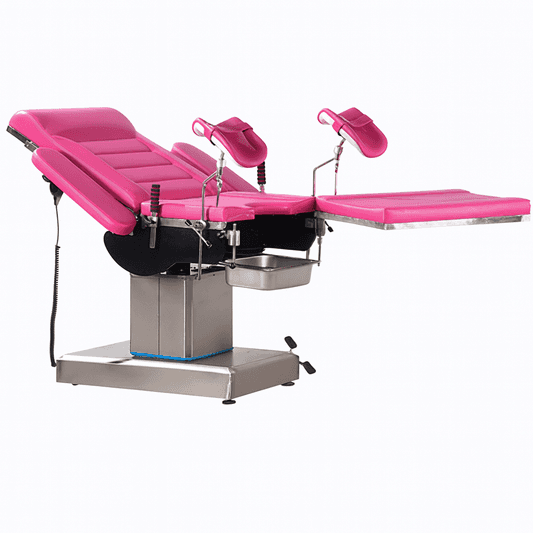
A delivery bed is the one piece of equipment in a maternity room that has to do four jobs at once: hold a labouring patient comfortably for hours, convert in seconds into a delivery platform with the right access and angles, survive daily disinfection for a decade, and do all of it without a technician on call. Which is why the choice between a manual, hydraulic and fully electric bed is not simply a budget question — it is a question about who will operate it, how often, and what happens when the power goes out. This guide covers the mechanisms, the positions that matter clinically, the specifications to put in your purchase order, and the safety documentation to ask for before importing.
The Three Mechanisms
| Type | How it adjusts | Best suited to | Trade-offs |
|---|---|---|---|
| Manual (crank) | Hand cranks for height, back and leg sections | Rural clinics, NGO programmes, unstable grids, low delivery volume | Lowest purchase price, nothing to fail electrically; slower to reposition, physically demanding for staff |
| Hydraulic / semi-electric | Foot-pedal hydraulic pump for height, cranks or actuators for sections | Mid-volume clinics wanting fast height change without full electrics | Fast height adjustment with no power dependency; section changes still partly manual |
| Fully electric | Linear actuators on all sections, hand control and often foot control | Hospitals and high-volume maternity units | Fastest, easiest on staff, supports one-person repositioning; higher price, needs reliable power, battery backup and service support |
The practical rule: the more deliveries per month and the fewer staff per delivery, the more an electric bed pays for itself in time and in staff injury avoided. For a clinic doing a handful of deliveries a week with reliable hands and unreliable electricity, a well-built manual or hydraulic bed is not a compromise — it is the correct specification. (hospital and delivery beds)
The Positions That Matter
A delivery bed earns its keep through the positions it can reach quickly:
- Height adjustment — brings the perineum to the attendant's working height; the single biggest ergonomic factor for staff
- Backrest (Fowler / semi-Fowler) — supports the labouring patient sitting up, and the pushing position
- Trendelenburg and reverse Trendelenburg — the emergency positions; Trendelenburg is used in obstetric emergencies such as cord prolapse and hypotension, so confirm the bed reaches a usable angle, not a token tilt
- Leg section removal or retraction — converts the bed from labour mode to delivery mode; on LDR-style beds the foot section slides or folds away rather than detaching
- Lithotomy support — via leg crutches or knee supports, adjustable in height, abduction and rotation
- Lateral tilt or lateral positioning aids — supports left lateral positioning where the bed offers it
Ask the factory for the actual degree range on each section, and for a short demonstration video of the bed moving through labour-to-delivery conversion. The conversion speed is what staff will judge the bed on within a week of installation.
Accessories and Components to Itemize
Two quotes for "obstetric delivery bed" become comparable only when the accessory list is spelled out. The usual set: adjustable leg crutches or knee supports with pads, foot rests, a stainless steel drainage basin (removable for cleaning), a mattress in sections with the section count and thickness stated, an IV pole, hand grips or handles for the pushing stage, side rails where offered, castors with a central or per-wheel braking system, and a newborn platform or infant tray on some models. Paper roll holders, mattress covers and patient-transfer aids are common extras.
Ask specifically which items are included and which are optional line items — the accessory set can move the delivered price meaningfully, and a bed that arrives without leg supports is not a bed.
Specifications to State in the Purchase Order
Dimensions and working load. Overall length and width, the height range at minimum and maximum, and the safe working load. Working-load ratings vary widely by model and by market expectation, so treat any single figure as model-specific and get the rating for the bed you are buying in writing.
Frame and surfaces. Stainless steel or epoxy-powder-coated steel frame, ABS or stainless side panels, and a mattress with seamless, welded upholstery — seams are where disinfectant fails and contamination survives. Confirm the upholstery's compatibility with the disinfectants your facility actually uses; some formulations degrade PU covers.
Castors and stability. Wheel diameter, central locking, and whether a fifth wheel or steering castor is offered for moving a loaded bed.
Electrical specification (electric models). Voltage and frequency for the destination grid, plug or IEC cord set, actuator duty cycle, battery backup, hand control ingress protection (IP rating — a maternity room is a wet environment), and an emergency lowering or CPR release. Getting the voltage build right at order time is not optional; our importing guide covers voltage, plugs and certificates by region. (Importing Medical Equipment: Voltage, Plugs and Certificates by Region)
Service and parts. Actuator and controller warranty separately from the frame, plus the availability and price of replacement actuators, hand controls and mattresses. On an electric bed, the actuator is the part that will need replacing first.
Standards and Documentation
The reference standard for medical beds is the IEC 60601-2-52 particular standard, which in 2026 was republished in renumbered form as IEC 80601-2-52, "Medical beds for adults", covering both manual and electrically operated beds. It addresses the safety issues that matter in practice: entrapment gaps in side rails and the mattress support, stability and load, mechanical strength, and — for powered beds — electrical safety alongside the general IEC 60601-1 requirements. Delivery beds sit near the edge of that standard's scope, so rather than assuming, ask your supplier which standard the bed was tested to and for a copy of the report.
On the regulatory side: in the EU, hospital and delivery beds are medical devices under the MDR, with the class depending on the device and its intended purpose — ask for the CE certificate or Declaration of Conformity naming this model and its class, plus the manufacturer's ISO 13485 certificate. For the US and most other markets, confirm the registration route with your local agent before ordering, since the registration holder is typically a local entity rather than the factory.
Shipping and Installation
Delivery beds ship knocked down or semi-assembled in wooden crates; ask for crate dimensions and gross weight per unit so you can plan the container properly, and for the assembly manual in advance so your technicians are not learning on the day. Confirm what assembly is required on site, whether tools are included, and what the supplier provides in the way of installation instructions or a commissioning checklist. For clinics equipping a maternity room from scratch, the bed usually ships alongside the rest of the room's equipment in one consolidated shipment. (Setting Up a Small Clinic: Essential Equipment Checklist & Budget)
FAQ
Is an electric bed worth the extra cost for a small clinic? Usually only when delivery volume or staffing makes repositioning speed matter, or where staff injury from manual cranking is a real concern. With an unstable grid and few deliveries, a hydraulic or manual bed with good ergonomics is the sounder purchase — and a second manual bed often beats one electric bed.
What happens to an electric bed during a power cut? Models with battery backup continue to operate for a period, and most offer an emergency mechanical lowering for the back section. Confirm both features exist before ordering for any facility with unreliable power — this is the question that separates specifications on paper from beds that work.
Can leg supports and accessories be added later? Usually yes, if the bed's mounting rails or sockets accept them, but fit is model-specific. The cheaper path is to order the full accessory set with the bed rather than sourcing parts afterwards.
How long should a delivery bed last? Frames outlive their electronics comfortably; actuators, hand controls and mattresses are the wear items. Judge a supplier by whether those parts are stocked and priced, not by the warranty headline.
Can delivery beds ship with other equipment in one order? Yes — beds consolidate well with examination and clinic equipment in a single shipment, which is how most clinic fit-outs are supplied. (full product range)
Equipping a maternity room or supplying a hospital tender? Tell us your destination market, quantity and the accessory set you need — we'll confirm specifications, voltage build, crate dimensions and the document pack. → HOPE INTERNATIONAL