Medical Oxygen Concentrator Buying Guide: 5L vs 10L, Purity and the Specs That Matter
September 27, 2026
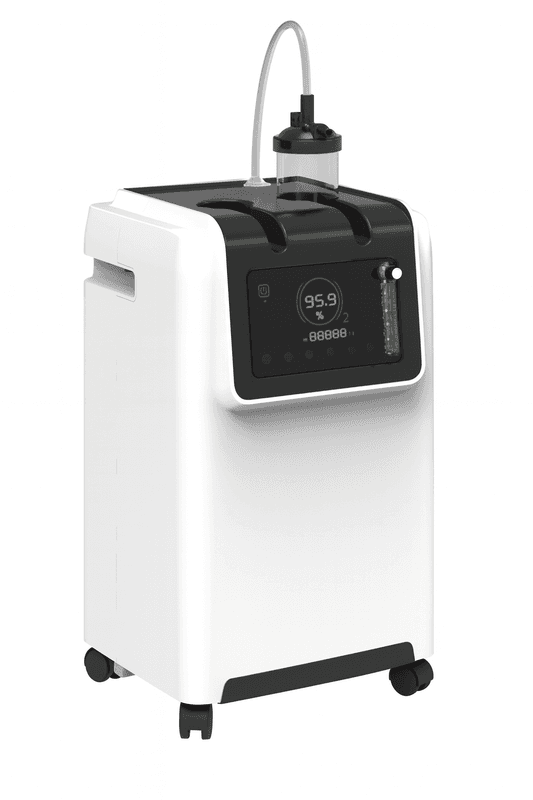
Oxygen concentrators became one of the most-searched medical devices in the world for good reason: they turn room air into medical-grade oxygen with no cylinders, no refills and no logistics chain. But the spec sheets are full of numbers that look alike. This guide explains the ones that actually matter — and how to choose between the common 5L and 10L classes.
How a Concentrator Works (in One Paragraph)
A concentrator pulls in room air (about 21% oxygen), compresses it, and passes it through zeolite molecular sieve beds that trap nitrogen — a process called pressure swing adsorption (PSA). Two sieve beds alternate so output is continuous. What comes out is 90%+ oxygen delivered through a flowmeter, humidifier bottle and nasal cannula.
The Number One Spec: Purity at Rated Flow
Medical-grade concentrators deliver 93% ± 3% oxygen purity at their rated flow — the benchmark used by international standards for these devices (ISO 80601-2-69). The catch: purity is only guaranteed up to the rated flow. A "5L" machine pushed to 5 L/min should still hold ~90%+; a lightweight unit re-labeled optimistically will see purity collapse at the top of its range. Always ask for the purity-vs-flow table, and prefer models with a purity indicator or low-purity alarm.
Flow Classes and Who They Serve
| Class | Typical Use | Notes |
|---|---|---|
| 1–3 L/min | Low-flow homecare, elderly wellness use | Compact and quiet; verify medical vs "wellness" grade |
| 5 L/min | The homecare and clinic standard | Covers the majority of prescribed low-flow therapy |
| 10 L/min | Higher-flow patients; clinics and wards | Also used with flow splitters to serve two low-flow patients in field programs |
| 20 L/min | Institutional / multi-bed use | Ward backup where piped oxygen is unavailable |
Our own range maps directly onto these classes — from the HP-V01 1L unit to the HP-V06 20L model, with the 5L HP-V03/HP-V04 and 10L HP-V05 as the volume sellers. (oxygen concentrators)
5L or 10L? The Practical Answer
Choose 5L when the machine serves one homecare patient on typical low-flow therapy — it's cheaper to buy and run, lighter and quieter. Choose 10L when any of these apply: prescriptions may exceed 5 L/min; the unit will serve a clinic treatment room with varied patients; you're an NGO or distributor supplying programs where one machine may support two cannulas via a splitter; or you simply need headroom so the machine never runs at 100% duty. As a reference from our current price list, the jump from a 5L unit (from $195) to the 10L HP-V05 ($642) buys double the flow ceiling and heavier-duty internals.
The Rest of the Spec Sheet, Decoded
- Noise (dB): homecare units should sit in the 40s–low 50s dB; ward units can be louder
- Power draw (W): drives running cost — relevant where electricity is expensive or solar-backed
- Alarms: power failure, low purity, high/low pressure — a safety baseline, not a luxury
- Duty cycle: continuous-rated compressors matter for clinic use; ask for the compressor's rated lifetime hours
- Extras: nebulizer outlet and dual-flow outlets are common on 10L models
- Voltage: confirm 110V vs 220V build and plug type for the destination country
Maintenance: Small, but Non-Negotiable
Gross particle filters wash weekly; intake filters replace on schedule; humidifier bottles use distilled water; sieve beds age over thousands of hours and are the main long-term wear part. For distributors, stocking filters and cannulas alongside machines is an easy margin line and improves end-user outcomes.
FAQ
Is 93% purity enough — why not 99%? 93%±3% is the medical standard for concentrator therapy; cylinder oxygen is ~99% but requires refilling logistics. Clinically, prescribed flow matters more than the last few purity points.
Can a concentrator run 24/7? Continuous-rated models are designed for it; check the duty-cycle rating and keep filters clean and ventilation clear.
What's the expected lifespan? Typically several years of daily use, with sieve bed replacement as the main mid-life service item; compressor rated hours are the number to compare.
Do you support mixed orders? Yes — machines can ship alongside our ultrasound, delivery bed and sterilizer lines in one consolidated shipment. (full product range)
Distributor or clinic? Send your quantity and destination — we'll quote models, voltage variants and shipping. → HOPE INTERNATIONAL