Ultrasound Probes Explained: Convex, Linear, TV — Which Do You Need?
September 27, 2026
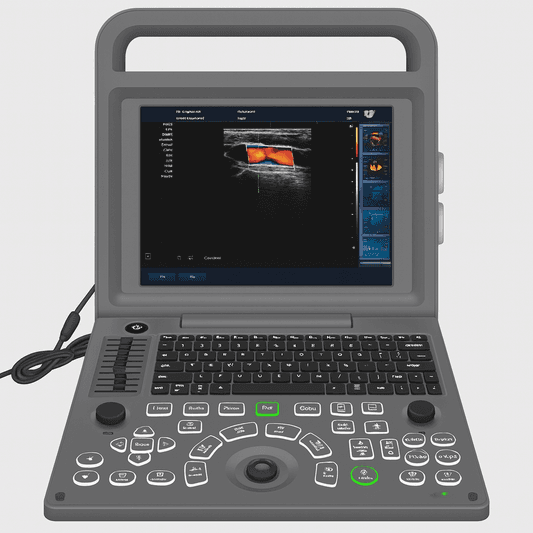
When a clinic buys an ultrasound machine, the console gets the attention — but the probes decide what the machine can actually do. A transducer is not an accessory; it is the part that determines image depth, resolution and which exams are possible. Buy the wrong set and an expensive scanner sits idle for half its intended caseload. This guide explains the main probe types, the frequencies that define them, and how to match a probe set to the work you run.
Why Frequency Is the Master Variable
Every probe is a trade-off between penetration and resolution, and frequency controls both. Low-frequency probes (roughly 2–5 MHz) send sound deep into the body but resolve fine detail less sharply — ideal for abdomen and obstetrics. High-frequency probes (roughly 7–15 MHz) deliver crisp near-field detail but cannot reach deep structures — ideal for superficial vessels, thyroid and small parts. Understanding that single trade-off explains almost every choice below.
The Main Probe Types at a Glance
| Probe Type | Typical Frequency | Field of View | Primary Clinical Uses |
|---|---|---|---|
| Convex (curvilinear) | 2–5 MHz | Wide, fan-shaped | Abdomen, obstetrics/gynecology, urology |
| Linear | 7–15 MHz | Rectangular | Vascular, thyroid, breast, small parts, MSK, nerve |
| Phased array (cardiac) | 2–7.5 MHz | Small footprint, sector | Cardiac, transcranial, lung |
| Endocavity / transvaginal (TV) | 5–11.5 MHz | Curved, end-firing | Early OB, gynecology, prostate (transrectal) |
| Micro-convex | 4–8 MHz | Small curved | Pediatric, neonatal, veterinary |
| 3D/4D volume | 4–8 MHz | Volumetric | Fetal imaging, gynecology |
| CW pencil Doppler | 2–8 MHz | Non-imaging | Peripheral vascular flow, cardiac velocities |
Convex: The Everyday Workhorse
The convex, or curvilinear, probe is the one most clinics use most of the time. Its curved face produces a wide, fan-shaped image and its low frequency (typically 2–5 MHz, with broadband models reaching higher) penetrates deep enough for the whole abdomen, the gravid uterus, the kidneys and the bladder. If a general-practice or maternity clinic buys only one probe, this is it. For growth scans, dating, organ surveys and residual-urine checks, the convex probe covers the bread-and-butter caseload.
Linear: Detail Near the Surface
The linear probe trades depth for resolution. Its flat face and high frequency (about 7–15 MHz) produce a sharp rectangular image of everything close to the skin: veins and arteries for vascular access, the thyroid and breast, tendons and joints for musculoskeletal work, nerves for guided blocks, and superficial lumps. Any clinic doing vascular access, small-parts or MSK work needs a linear probe alongside the convex — the two together cover the majority of general imaging.
Phased Array: Imaging Between the Ribs
The phased array probe has a small footprint that fits into the narrow acoustic windows between ribs, producing a sector (triangular) image from a tiny contact point. That geometry is what makes it the cardiac probe — it can see the heart without the ribs blocking the view — and it also serves transcranial and lung imaging. If your caseload includes echocardiography, this probe is non-negotiable; if it does not, you can often skip it. Note that cardiac scanning also depends on the machine itself supporting the right modes, which is a reason many cardiac buyers choose color Doppler systems. (B/W vs Color Doppler Ultrasound: Which Is Right for Your Clinic?)
Endocavity / Transvaginal (TV): Getting Close to the Target
Endocavity probes are shaped to fit a body cavity and image from the inside, at higher frequencies (around 5–11.5 MHz) because the target is close to the probe face. The transvaginal (TV) probe is the common one — indispensable for early-pregnancy dating, ovarian and uterine assessment, and gynecology, where it gives far better resolution than scanning through the abdominal wall. The transrectal variant serves prostate imaging. For any clinic with an obstetric or gynecological caseload, a TV probe is usually the second or third purchase after the convex.
Specialty Probes: Micro-Convex, Volume and CW
Micro-convex probes are compact curved transducers for small patients — pediatrics, neonatal cranial scanning, and veterinary pregnancy checks — where a full-size convex footprint won't fit. 3D/4D volume probes reconstruct volumetric images, most visibly for fetal face imaging but clinically useful in gynecology. CW (continuous-wave) pencil probes are non-imaging Doppler-only transducers for measuring blood-flow velocities in peripheral vascular and cardiac work. These are add-ons bought for a defined need, not part of the starter set.
How to Choose Your Probe Set
Work backwards from your exam list, not the brochure. A practical starting logic:
- General practice / rural clinic: convex first; add linear for vascular and small parts.
- Maternity clinic: convex plus transvaginal; add a volume probe if you offer 4D.
- Checkup / screening center: linear (thyroid, breast, carotid) plus convex.
- Cardiology: phased array, on a machine with the cardiac and Doppler modes to match.
- Pediatric / veterinary: micro-convex plus linear.
Two buying rules save money and regret. First, confirm the connector count and compatibility — how many probes can plug in at once, and whether the socket supports the models you may add later, so you are not locked out of an upgrade. Second, budget probes as a warranty risk: transducers fail more often than consoles, and probe repair or replacement is a significant line item, so ask for the separate probe warranty term and spare-probe pricing before you commit. (ultrasound scanners)
FAQ
Which probe should I buy first? For general and obstetric work, the convex probe — it covers the widest range of exams. Add a linear probe next for vascular and superficial imaging.
Can one probe do everything? No. Frequency forces a trade-off between depth and detail, so no single transducer covers both deep abdominal and fine superficial imaging well. Most clinics run two to three probes.
Are probes interchangeable between machines? Only within a compatible connector system. Probes are matched to a manufacturer's socket and software; confirm compatibility before assuming a probe will move between consoles.
Do I need a phased array probe? Only if you scan hearts. For abdomen, OB/GYN and small-parts work, convex and linear probes are what you use daily.
How long do ultrasound probes last? Several years with careful handling, but they are the most failure-prone part of the system — dropped probes and cable damage are common. Factor a probe warranty and a spare into the purchase. (send an inquiry)
Not sure which probes fit your caseload? Tell us your top exam types and the machines you run — we'll recommend a probe set with frequency specs, compatibility notes and pricing. → HOPE INTERNATIONAL