Wheelchair Size Chart: How to Measure Seat Width, Depth and Height for Adult Users
October 27, 2026
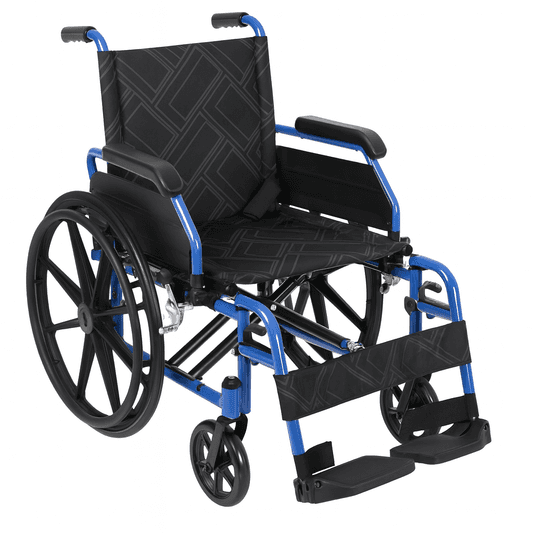
The returns in this category are not quality failures. They are fit failures, arriving in twos and threes over the first quarter: a chair that will not pass the ward door, one whose seat is two inches too wide so the user slides and the armrests are useless, one whose seat height leaves the footplates grounding on a ramp. Every one was orderable, in spec, and wrong — and the freight back is on somebody.
It keeps happening because buyers compare seat width while the building cares about overall width, and those two numbers are rarely on the same line of an offer sheet.
The four measurements that decide fit
Take them from the user, not from the chair. Each one maps to one body dimension.
| Chair dimension | Measure this on the user | What goes wrong if it is off |
|---|---|---|
| Seat width | Widest point across the hips and thighs, seated, plus a small allowance for clothing | Too narrow presses at the hips; too wide and the user leans, the armrests stop supporting, and the chair gets wider than the doorway for no benefit |
| Seat depth | Back of the buttock to the back of the knee, seated — then leave clearance behind the knee | Too deep and the front edge loads behind the knee; too shallow and thigh support is lost |
| Seat height | Underside of the thigh to the sole, with the shoe on | Sets footplate clearance over the ground and whether the user can reach the floor or a desk |
| Back height | Seat surface up to the support level the user needs | Too high restricts a self-propelling user's shoulders; too low gives no postural support |
Adult seat widths cluster on a small number of steps — 16, 18 and 20 inches, roughly 41, 46 and 51 cm — and most institutional fleets are bought on those three. That is a stocking convention, not a standard: specify the figure in the unit your market orders in, and have the supplier confirm it per model rather than per range.
For a long-term user, none of this replaces assessment: a chair someone sits in all day is a seating prescription measured by a therapist, and a distributor selling into that market without saying so is storing up a problem. Fleet and rental stock is a different purchase, and that is the one here.
Overall width is the number the building cares about
Here is the measurement that is missing from most comparisons. Seat width is a seating dimension; overall open width is the chair at its widest point, and that is what has to pass the door. The frame, the hand rims and the armrest panels all sit outboard of the upholstery, so the open width is always greater than the seat width — typically by a few inches, as a planning figure in this trade rather than a guarantee, and the exact increment varies by model and by rim choice.
Two consequences, both financial:
- Doorway and lift fit. A ward door, a bathroom door and a lift car each have a clear opening, and the chair that fits the user may not fit the route. Get the overall open width per model and check it against your customer's narrowest door before the order, not after.
- Cube. Folded width drives cartons per container, and overall width drives it in storage. A chair that is an inch wider across the frame at the same seat width costs you container slots on every shipment for the life of the award.
There is a standard for exactly this disclosure. ISO 7176-5 sets out the methods for determining wheelchair dimensions and mass — including outside dimensions with a reference occupant seated — and the manoeuvring space needed for everyday use, and it also governs how those dimensions and masses are to be disclosed. Its annexes cover performance-relevant technical dimensions, pivot and reversing width, and turning diameter. There is a companion technical report, ISO/TR 13570, which publishes typical values and recommended limits for the important dimensions, ready-for-occupation and folded, together with the space needed to pivot or reverse between two walls.
That gives you a clean request: give me the ISO 7176-5 dimensions for this model, not the catalogue summary. Seating dimensions have their own part — ISO 7176-7, measurement of seating and wheel dimensions — so ask which part a figure was measured under. A supplier who can answer has a dimension file; one who sends a four-number marketing sheet does not.
Where two "18-inch" chairs differ
In rough order of money:
- Where the seat width was measured — between the upholstery, between the armrest panels, or across the frame. Three different numbers, one label.
- Overall open width and folded width, which decide route fit and cube and are frequently absent from the offer.
- Rated user weight, and whether it was established against a strength standard or asserted.
- Net weight and what is included — with or without footrests, with or without rear wheels.
- Rear wheel and hand rim choice, which moves both overall width and self-propelling usability.
- Upholstery and cushion, which quietly changes effective seat width and depth against the frame figure.
A note on rated user weight, because it is the one figure buyers treat as marketing: it is a safety claim. Ask for the strength evidence behind it — ISO 7176-8 covers static, impact and fatigue strength requirements and test methods — and check that the report names the model you are buying, not a sibling. "Heavy duty" without that report is an adjective.
What to put in the schedule
- Destination market and the regulatory route, which sets the labelling and document pack before anything technical.
- Per line: model, seat width, seat depth, seat height, back height — each with the measuring points stated.
- Overall open width and folded dimensions per model, and the narrowest door the chair must pass at the customer's site.
- Rated user weight per model, with the strength report reference.
- Net weight per model, stating what is included.
- Rear wheel size, tyre type and hand rim choice; armrest and legrest type.
- Carton dimensions, assembled or knocked down, and cartons per container.
- Inspection stage, who pays, and the annual volume behind the first order.
Inspection and the AQL question
Sampling is the uncontroversial half: pull against ISO 2859-1, general inspection level II, with the lot defined as the production batch, plus a during-production check and a pre-shipment check on packed cartons.
The acceptance figure is where buyers drift, and the drift comes from a glove standard. Durable equipment carries no statutory acceptance number; the category where one is written into law is examination gloves, where the US applies AQL 2.5 under 21 CFR 800.20 and the EU AQL 1.5 under EN 455-1. A supplier offering "the industry-standard AQL 1.5" for wheelchairs has read it off a product they are not selling you. Define the classes with named examples instead, and make the dimensional ones explicit: seat width out of tolerance against the declared measuring point, overall width over the declared figure, seat height out of tolerance, cross-brace stiffness out of range, brake not holding on the test gradient, castor play, upholstery misaligned, wrong footrest variant packed, carton crush, missing tool or manual. We accept the inspection company you nominate, or we use the inspection company we work with on a continuing basis.
Freight, cube and the tariff line
| Commercial term | What to fix in the purchase order |
|---|---|
| Carton specification | Folded chair dimensions and carton dimensions per model and per seat width, gross and net weight, and whether the chair ships assembled or knocked down |
| Loadability | As planning figures only: 20ft roughly 26–28 m³, 40ft 55–58 m³, 40HQ 65–68 m³. Chairs cube out long before they weigh out, so cartons per container is the number to negotiate — and it moves with seat width, so quote it per size |
| Pallet configuration | Pallet type, cartons per tier, tiers per pallet, pallet-in or loose-loaded, and whether heat-treated pallets are required at your port |
| Incoterm and port of loading | State both. An EXW number, a FOB number and a DDP number are three different prices; compare only like with like, and check your own duty line first. Ask your supplier to state the Incoterm and named port of loading in the quotation |
| HS line | Heading 8713 covers carriages for disabled persons; 8713.10 is the not-mechanically-propelled subheading carrying manual chairs. US importers should also look at Chapter 98 provisions 9817.00.94–96 for articles specially designed for the handicapped, which turn on permanent or chronic impairment rather than acute use. Confirm both against your own tariff before you compare a landed figure |
| Price and payment | Indicative USD per unit against current steel and aluminium input costs, with a stated validity window and the payment terms named in the order. Metal-framed goods priced open-endedly usually have room in the tube wall or the finish |
Price, minimum order quantity and lead time are confirmed with each quotation, against your specification and destination market.
Warranty, spares and liability
Durable equipment is bought on the warranty and the spares tail. No single figure is published for either, because the frame, the wheels and the soft goods do not carry the same terms — we confirm both per model with the quotation. What to get in writing from every supplier on your list, including us, is these five:
- Warranty period and the date it starts — shipment or receipt. On a sea shipment that is weeks.
- Scope: which parts, and whether frame, cross brace, castors and upholstery sit in different buckets.
- Parts versus labour, and who pays freight on a warranty part.
- DOA window and who pays return freight.
- Spare parts availability in years, by model, and whether parts are sold to you or only through a service channel.
On liability, three fields belong on your file: the legal manufacturer named on the chair and the carton, the EU authorised representative or responsible person where you sell into Europe, and the US agent of record where one applies. Ask every supplier for all three in writing. We confirm ours for your destination market with the quotation rather than printing it on a web page.
Change control and traceability
The third order is where this goes wrong, not the first. Ask for a written change notification policy covering a change of tube supplier, castor or brake sub-supplier, upholstery fabric, coating process or assembly site. A change of upholstery supplier is the one most often treated as internal — it is not, because cushion and upholstery thickness change the effective seat width against the frame figure your customer measured.
Ask for a serial or batch mark on the frame and the carton so a complaint traces to one production batch, and for the numbering key with the first shipment. Our policy: we notify specification changes in writing; that notification is for your records — we do not hold production for a written approval from you. If your quality system needs an approval gate, raise it at the purchase order stage so it sits in the terms.
When a size chart is the wrong tool
If you are supplying a single long-term user, do not buy off a chart at all — that is a prescription, measured by a therapist, and the chair is usually configurable rather than stocked. Equally, if your customer's bottleneck is a narrow bathroom door rather than the user's hips, the answer may be a transport chair with small rear wheels, which is narrower across the frame at the same seat width and cheaper besides. The most common version of this expensive mistake is a fleet ordered on seat width alone, delivered correctly, and unable to enter half the rooms it was bought for. If the requirement is powered mobility, a manual frame does not answer it; that is a different product category.
What to send us
Send your destination market, the models on your shortlist, your seat-width split, the rated user weight you need to cover, and the narrowest doorway the chairs must pass. Ask for the ISO 7176-5 dimensions per model, the strength report reference behind the rated weight, folded carton figures per size so you can do the cube maths, and the document pack for your market.
Start from the wheelchairs for hospitals and distributors range, then compare the three reference frames by dimension rather than by description: the HP-Y01 aluminum functional wheelchair, the HP-Y02 lightweight aluminum wheelchair and the HP-Y03 steel wheelchair. Awards in this category travel with neighbouring lines, so the mobility aids supplier collection is worth opening alongside. For how chairs sit in a wider opening order, see our small clinic equipment checklist.
FAQ
Can you give me the overall open width, not just the seat width? Ask for the ISO 7176-5 dimensions per model, including open and folded width, and have them confirmed with the quotation. Overall open width is the figure your customer's doorway cares about and the one that sets your cartons per container, so it belongs in the offer rather than left to be inferred.
How is the minimum first order set — by model or by seat width? Ask for the minimum per model and per seat width, because each variant is its own build and its own carton. On a mixed order the binding minimum is usually the least popular seat width rather than the chairs overall. The figure comes with the quotation for your mix.
What does the warranty cover and when does it start? The period, the start date, the parts-versus-labour split and the freight position are confirmed per model with the quotation. Any supplier offering one warranty sentence for a whole catalogue has not read their own bill of materials.
Can you send a sample chair before we commit to a fleet order? We supply samples free of charge. Tell us the models and seat widths; a sample settles folding effort, brake feel and the actual open width in a way no specification sheet does.