Steel vs Aluminum Wheelchairs: Weight, Durability and Which Frame to Stock
October 26, 2026
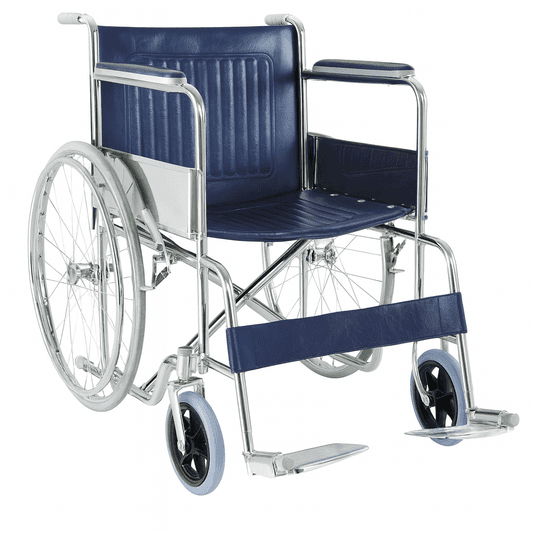
The frame material is the decision buyers argue about and the one that moves the invoice least. What moves the invoice is the folded carton: wheelchairs are a volume cargo, and a chair that folds 60 mm wider than its competitor costs you container slots on every order for the life of the award. Two quotations can sit within a couple of dollars at the unit and land four figures apart per container, and the frame alloy has very little to do with it.
So treat the material question as a fitness question and the money question as a cube and documentation question. They are not the same conversation.
What the frame material changes — and what it does not
| Attribute | Steel frame | Aluminium frame |
|---|---|---|
| Relative frame weight | Heavier for the same geometry | Lighter for the same geometry |
| Tolerance of rough handling | Takes knocks and institutional abuse well; dents rather than cracks | Good, but a hard impact is more likely to bend permanently |
| Typical finish | Powder-coated or chrome-plated; chrome shows transit marks and chips at the edges | Coated or anodised; corrosion behaviour differs from plated steel at the scratch |
| Corrosion exposure | Plating or coating breach starts rust; matters in humid and coastal service | More forgiving in humidity, which matters for wet-room and poolside use |
| Repair in the field | Welded repair is straightforward almost anywhere | Welded repair needs the right process; often a replacement-part decision instead |
| Cost tier | Usually the economy tier for wards, tenders and donation programmes | Usually a step up, bought for lift-in-the-car and self-propelling use |
| Freight | Folded dimensions, not material, set the cartons per container | Same — the lighter chair is not automatically the cheaper chair to ship |
What the material does not decide: seat width, seat depth, back height, rear wheel size, armrest and legrest type, and the rated user weight. Those decide whether the chair fits the user, and they vary within a material far more than between materials. A ward that ordered "aluminium, because lighter" and received a 16-inch seat for a bariatric cohort has a fitment problem the alloy cannot solve.
Nor does it decide the net weight, which is the figure that actually gets compared. Published weights across the market are quoted inconsistently — with or without footrests, with or without rear wheels, sometimes as a transport weight. Ask for the net weight and the rated user weight from each model's own specification sheet, stated with what is included, and compare those. Ask for both figures per model with the quotation, rather than accepting a single range-wide number that would not be true of every chair in it.
Titanium sits one step further: lighter again and better at damping vibration, which matters to full-time active users on custom chairs. It is also considerably dearer and generally built to individual measurement. For an institutional fleet or a distributor's stock range it is the wrong tier.
The Class I assumption that costs a US importer a quarter
Here is the trap worth the price of the article. A manual wheelchair is a mechanical wheelchair under 21 CFR 890.3850, Class I, general controls — and a great many buyers read "Class I" as "exempt from premarket notification". For this device, the published regulation grants no such exemption. The neighbouring section for mechanical walkers states its exemption expressly; the wheelchair section stops at the Class I designation, and FDA has in fact granted premarket clearances for mechanical wheelchairs under this regulation, including a manual wheelchair as recently as 2025.
The practical consequence: if you are the importer bringing a new manual chair into the United States, confirm in writing what the premarket position is for that exact model and that exact labelling, with the product code, before you book production. Discovering it at the border is a storage bill plus a season.
The same discipline applies to the bits buyers skip because the product looks simple:
| What to ask for | What it is | Why it is on your file and not theirs |
|---|---|---|
| ISO 7176-8 report | Static, impact and fatigue strength requirements and test methods | The one report that speaks to frame durability claims; "heavy duty" without it is an adjective |
| ISO 7176-3 report | Brake effectiveness | The first thing a care-home inspector tests and the commonest in-service complaint |
| EN 12183 report | Manual wheelchairs — requirements and test methods | There is more than one edition in circulation; ask which edition the report is written against |
| ISO 7176-19 position | Wheelchairs for use as seats in motor vehicles | Only applies if the chair will be occupied in transit — but if your customer is a transport operator it is pass or fail, and ANSI/RESNA WC19 is the related North American scheme. Settle which one the report covers |
| Rated user weight basis | The declared maximum occupant mass | It is a safety claim, not a marketing figure, and it has to match the test report you were given |
A supplier who sends you a certificate with a scope line covering a different model number has sent you nothing. Read the scope and the model list, not the logo.
Where two quotations for the same chair differ
In rough order of money:
- Folded carton dimensions, and therefore cartons per container. This is first, and it is almost never on the comparison sheet.
- Test report coverage, per model rather than per range, against the current edition of the standard.
- Component grade: castor bearings, rear wheel and tyre type, brake assembly, upholstery fabric and its flammability position.
- Finish: powder coat thickness or plating quality, which is what decides whether the fleet looks tired in year two.
- Spare parts policy: whether footrests, armrests, castors and brake parts are orderable separately and for how long.
- Assembly state: knocked-down versus assembled changes both the cube and your receiving labour.
Freight, cube and the tariff line
| Commercial term | What to fix in the purchase order |
|---|---|
| Carton specification | Folded chair dimensions and carton dimensions per model, gross and net weight, and whether the chair ships assembled or knocked down |
| Loadability | As planning figures only: 20ft roughly 26–28 m³, 40ft 55–58 m³, 40HQ 65–68 m³. Chairs cube out long before they weigh out, so the cartons-per-container figure is the number to negotiate |
| Pallet configuration | Pallet type, cartons per tier, tiers per pallet, pallet-in or loose-loaded, and whether heat-treated pallets are required at your port |
| Incoterm and port of loading | State both. EXW, FOB Ningbo and DDP are three different prices; compare like with like and check your own duty line first |
| HS line | Heading 8713 covers carriages for disabled persons; 8713.10 is the not-mechanically-propelled subheading that carries manual wheelchairs, with scooters and transport seats sitting elsewhere in the heading. US importers should also look at the Chapter 98 provisions 9817.00.94–96 for articles specially designed for the handicapped, which turn on permanent or chronic impairment rather than acute use. Confirm both against your own tariff before you compare a landed figure |
| Price basis | Indicative USD per unit against current steel and aluminium input costs, with a stated validity window rather than an open-ended price. Metal-framed goods priced open-endedly usually have room in the tube wall or the finish |
| Payment and inspection | Payment terms and the inspection stage named in the order, with who pays for the inspection stated |
The Chapter 98 row is the one US distributors most often leave on the table. Price, minimum order quantity and lead time are confirmed with each quotation, against your specification and destination market.
Inspection, and the AQL figure that does not belong here
Sampling is the uncontroversial half: pull against ISO 2859-1, general inspection level II, with the lot defined as the production batch, plus a during-production check while the line is running and a pre-shipment inspection on packed cartons.
The acceptance number is where buyers drift, and the drift comes from a glove standard. Durable equipment carries no statutory acceptance figure; the category where a number is written into law is examination gloves, where the US applies AQL 2.5 under 21 CFR 800.20 and the EU AQL 1.5 under EN 455-1. A supplier quoting "the industry-standard AQL 1.5" for wheelchairs has read it off a product they are not selling you. Define the classes with named examples instead: brake not holding on the test gradient, weld spatter or coating breach, castor play, cross-brace stiffness out of tolerance, upholstery misaligned, wrong footrest variant packed, carton crush, missing tool or manual. We accept the inspection company you nominate, or we use the inspection company we work with on a continuing basis.
Warranty, spares and who carries the liability
Durable equipment is bought on the warranty and the spares tail, not on the frame. Get these five in writing before the award, from every supplier on your list:
- Warranty period and the date it starts — shipment date or receipt date. On a sea shipment that is weeks of difference.
- Scope: which parts are covered, and whether the frame, the cross brace, the castors and the upholstery sit in different buckets.
- Parts versus labour, and who pays freight on a warranty part.
- DOA window and who pays return freight on a dead-on-arrival unit.
- Spare parts availability in years, by model, and whether parts are sold to you or only through a service channel.
On those five we confirm our position per model with the quotation rather than publishing a single policy, because the frame, the wheels and the soft goods do not carry the same terms.
On liability, three fields belong on your file: the legal manufacturer named on the chair and the carton, the EU authorised representative or responsible person where you sell into Europe, and the US agent of record where one applies. Ask every supplier for all three in writing, with entity names and addresses as they will appear on the label. We confirm ours for your destination market with the quotation rather than printed on a web page.
Change control and traceability
The third order is where this goes wrong, not the first. Ask for a written change notification policy covering a change of tube supplier, castor or brake sub-supplier, upholstery fabric, coating process or assembly site. A change of brake sub-supplier is the one most often treated as internal — it is not, because the ISO 7176-3 result travels with the assembly, not with the frame.
Ask for a serial or batch mark on the frame and the carton so a complaint traces to one production batch, and for the numbering key with the first shipment. Our policy: we notify specification changes in writing; that notification is for your records — we do not hold production for a written approval from you. If your own quality system needs an approval gate, raise it at the purchase order stage so it sits in the terms rather than in an assumption.
When neither frame is the right answer
If the use case is an attendant moving patients short distances inside a building, a transport chair with small rear wheels is usually the better buy in either material — cheaper, narrower through doorways and lighter to handle — and self-propelling rear wheels you are paying for will never be touched. Equally, if your cohort needs postural support, a reclining or high-back chair is a different product line and the steel-versus-aluminium question does not reach it. If the requirement is powered mobility, neither frame answers it; that is a different product category.
What to send us
Send your destination market, the models on your shortlist, your seat-width split, the rated user weight you need to cover, whether chairs will be occupied in transit, and your annual volume. Ask for the specification sheet per model with net and rated weights, the test reports available per model, and folded carton and pallet figures so you can do the cube maths before you compare unit prices.
Start from the wheelchairs for hospitals and distributors range, or go straight to the two reference frames: the HP-Y02 lightweight aluminum wheelchair and the HP-Y03 steel wheelchair. Awards in this category usually travel with neighbouring lines, so the mobility aids supplier and bathroom safety equipment wholesale collections are worth opening in the same session. For how this fits a wider opening order, see our small clinic equipment checklist.
FAQ
How is the minimum first order set — by model, by seat width or by container? Price, minimum order quantity and lead time are confirmed with each quotation, against your specification and destination market. Ask for the minimum per model and per seat width, because each variant is its own build and its own carton; on a mixed order the practical floor is often set by the smallest viable production run of the least popular seat width rather than by the chairs overall.
Which parts does the warranty cover, and when does it start? Ask every supplier for it per model in writing: the period, the start date, the parts-versus-labour split and the freight position. Ours are confirmed per model with the quotation. Any supplier giving you one warranty sentence for a whole catalogue has not read their own bill of materials.
Can you send a sample chair before we commit to a fleet order? We supply samples free of charge. Tell us the models and seat widths you want to assess; a sample settles folding effort, brake feel and finish quality in a way no specification sheet does.
How many chairs fit in a container? It depends on the folded carton, not the material, which is why you should ask for folded and carton dimensions per model up front. Use the planning ranges above for your own cube maths and treat any supplier's single "units per container" figure as a quotation input to be checked, not a fact.