Setting Up a Maternity Room: Equipment Checklist for Small Hospitals
October 26, 2026
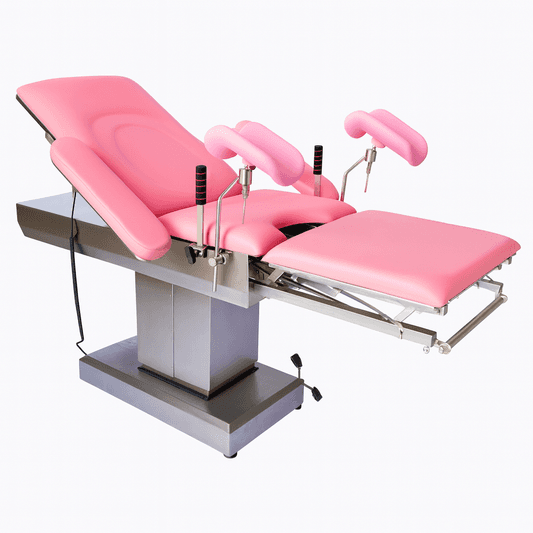
220V/50Hz and 110V/60Hz are two different SKUs, not a switch setting. On a maternity order that lesson usually arrives with the radiant warmer, because the heating element is the part that does not forgive a transformer — and by then the room has a commissioning date. Lock voltage, frequency, plug type and cord length at purchase order stage for every powered item on the list, including the ones a dealer treats as accessories.
The second thing to lock is quieter. A maternity room is not a list of machines; it is four stations that have to work at the same time, in the same room, on the same power and gas services. Buy by station and the gaps show up on paper. Buy by catalogue page and they show up on the night of the first delivery.
The equipment list, by station
| Station | Core items | What to specify beyond the model number |
|---|---|---|
| Delivery | Obstetric delivery bed, stirrups and leg supports, mattress, IV pole, step stool, examination light | Manual, semi-electric or electric; backrest and Trendelenburg range; mattress material and cleanability; whether the light is mobile or ceiling-fixed, and its colour temperature |
| Newborn resuscitation | Radiant warmer or resuscitation table, suction unit, oxygen source and blender, bag-valve-mask set in newborn sizes, infant scale, timer | Height and tilt range, skin temperature probe type and spares, suction regulator range, whether the oxygen fitting matches your wall system or a cylinder yoke |
| Maternal monitoring | Patient monitor, fetal doppler or cardiotocograph, blood pressure cuffs in several sizes, thermometer, pulse oximeter with adult and neonatal probes | Parameter set, probe compatibility and consumable part numbers, whether cuffs and probes are proprietary or standard fittings |
| Clean supply and instruments | Autoclave sized to the instrument load, instrument trolley, dressing trolley, kick bucket, storage cabinet | Chamber volume against your real tray list, cycle class against your load types, and water quality requirement |
| Neonatal holding | Infant cot or bassinet, phototherapy unit, transport incubator where your referral distance justifies it | Irradiance measurement method for phototherapy, lamp or LED service life, and whether a radiometer comes with the unit |
The item most often left off a first list is the second set of consumable accessories: neonatal probes, cuffs in three sizes, suction tubing, temperature probe covers, CTG paper and belts. Equipment arrives with one of each. A ward runs on three.
The standards that actually apply
Naming the right particular standard is the fastest way to sort a serious quotation from a catalogue reprint. The base safety standard for powered medical equipment is IEC 60601-1, and each device family adds its own part:
- Infant incubators — IEC 60601-2-19 (current edition 2020).
- Infant transport incubators — IEC 60601-2-20.
- Infant radiant warmers — IEC 60601-2-21 (2020 edition, with a 2023 amendment in the European adoption). Its scope deliberately excludes incubators, transport incubators and phototherapy equipment, each of which sits in its own part — a supplier offering one certificate for all four is showing you the wrong document.
- Infant phototherapy equipment — IEC 60601-2-50 (2020 edition, amended 2023).
- Patient monitoring — the parameter-specific parts, including IEC 60601-2-27 for electrocardiographic monitoring.
One detail from the warmer standard worth knowing before you compare specifications: a skin temperature sensor used to control a baby-controlled warmer is not treated as a clinical thermometer under ISO 80601-2-56. Accuracy claims for the two are not comparable, and a quotation that quotes a thermometer tolerance for a control sensor has mixed them up.
Ask for the test report, not the logo. The useful discipline is the same one that applies to laboratory reports: require the standard number and the edition on the certificate, because the 2020 editions replaced 2009 editions that are still quoted in circulating documents.
Regulatory route and who carries responsibility
| Market | Route | What to ask for in writing |
|---|---|---|
| EU | Regulation (EU) 2017/745, with the class following from Annex VIII and the intended purpose; infant incubators are routinely Class IIb, while non-active furniture sits far lower | The EU declaration of conformity for the exact model, the class and the rule it was classified under, and the notified body involvement where the class requires it |
| US | Device-specific route by product code, with establishment registration and device listing applying to the supplying site | The product code and the regulatory pathway for that code, stated per model rather than per range |
| Other markets | National registration, often requiring a free sale certificate and the home-market approval as a precondition | Which market's approval your registration consultant needs as the parent document, before the order is placed |
Three fields belong in your file for every powered item: the legal manufacturer named on the rating plate, the EU authorised representative where you import into Europe, and the US agent of record where that applies. These are not a formality — they decide who you write to when a device fails inside warranty and the dealer stops answering. Ask every supplier for all three in writing; we confirm ours for your destination market with the quotation.
Installation, commissioning and electrical safety
Three things decide whether the room opens on time, and none is in the product specification.
- Services. Oxygen and suction fittings, socket count and position, and whether your wall system matches the fittings quoted. Fittings are regional and are the most common reason a delivered warmer cannot be used on the day it arrives.
- Commissioning. Who unpacks, assembles, tests and signs off, and whether that is in the price or billed. For a small hospital buying direct, this is usually a local biomedical engineer, and they need the service manual, not the user manual.
- Acceptance testing. Agree an incoming electrical safety test against the in-service testing standard IEC 62353 and record the baseline values at handover. Without a baseline, the first annual test tells you nothing, and warranty arguments about electrical faults have no reference point.
Warranty, spares and the terms that matter after year one
Equipment is bought once and owned for a decade. The questions that decide the real cost are almost never asked at quotation stage. Put these in the purchase order:
- Warranty start date — shipment, arrival or commissioning. Sea freight and customs can consume a meaningful slice of the warranty period before the device is switched on.
- Parts versus labour, and whether wear items (lamps, probes, batteries, filters, sensors) are included or explicitly excluded.
- DOA window and who pays the freight on a dead-on-arrival unit, in both directions.
- Spare parts availability period in years after the model is discontinued, stated as a number.
- Serial number rules and where the plate sits, plus the software or firmware version where the device has one.
- Service documentation — service manual, wiring diagram, calibration procedure and error code list, supplied with the first unit rather than on request after a failure.
A supplier who answers all six in writing is telling you more about their after-sales reality than any brochure. In practice the one question that separates them is the spare parts period: dealers who sell many brands rarely know it, and a maternity room with an unserviceable warmer is not a spare parts problem, it is a clinical one.
Inspection, packing and the tariff lines
Equipment is not inspected the way consumables are. Each unit should get a functional test and a power-on check, and the AQL sampling conversation belongs to the consumables travelling in the same container, not to the machines. Where a statutory acceptance figure exists at all it is category-specific — examination gloves, for instance, where the US applies AQL 2.5 under 21 CFR 800.20 and the EU applies AQL 1.5 under EN 455-1, sampled per ISO 2859-1 general inspection level II. For the machines, specify instead: 100 per cent power-on test with the result recorded against the serial number, accessories checked against the packing list per unit, and crate integrity photographed before loading. We accept the inspection company you nominate, or we use the inspection company we work with on a continuing basis.
| Commercial term | What to fix in the purchase order |
|---|---|
| Packing | Carton or plywood crate per item, with crate dimensions, gross and net weight, and whether crates are stackable. Delivery beds and warmers are the two that decide your container plan |
| Pallet and container planning | A maternity room fit-out is a weight-and-shape problem rather than a cube problem; take cartons and crates per container from the loading plan, not from an estimate. As planning figures a 20ft box takes roughly 26–28 m³, a 40ft 55–58 m³ and a 40HQ 65–68 m³ of export cartons |
| Accessory reconciliation | Reconcile accessories by piece against the packing list per serial number. Probes and cuffs are the items that go missing between crate and ward, and a claim raised after installation rarely succeeds |
| Incoterm and port of loading | State both. An EXW number, a FOB Shanghai number and a DDP number are three different prices; compare only like with like |
| HS lines | A mixed equipment order spans headings: medical and surgical furniture including delivery and examination beds sits in heading 9402 (commonly 9402.90), instruments and appliances in heading 9018. Confirm each line against your own tariff before you compare a landed figure |
| Price basis | Indicative USD per unit with the accessory kit priced separately and a stated validity window, rather than one open-ended bundle number |
| Documents | Invoice and packing list split by HS line and serial number, declaration of conformity per model, test reports with standard number and edition, service manual, and the certificate your registration route needs |
Price, minimum order quantity and lead time are confirmed with each quotation, against your specification and destination market. A bundle price quoted without the accessory list behind it is a placeholder, whoever hands it to you — and on equipment the accessory list is where a cheap bundle gets its margin back.
Samples, demonstration units and the artwork-free advantage
Equipment has no print minimum, which removes the usual lead-time trap and introduces a different one: configuration. Voltage, plug, language of the interface and labelling, mains cord length and the accessory kit are all decisions that have to be made before production rather than after.
We supply samples free of charge. A sample or demonstration unit settles interface language, build quality and footprint, and it is worth assessing before a multi-room order.
Change control and traceability
Ask for the serial number on the unit, the crate and the packing list so a service case traces to one build, and for the serial number range to travel with the shipping documents. Our own policy: we notify specification changes in writing; that notification is for your records — we do not hold production for a written approval from you. If your tender or your ministry registration is tied to a specific build, raise it at the purchase order stage so it sits in the terms.
The change that catches buyers out on repeat orders is a component swap inside the same model number — a different probe connector, a different battery, a different lamp. Ask for notification specifically on connector, battery and lamp changes, because those are what makes your second order incompatible with your first order's spares shelf.
When buying the full room at once is the wrong call
If your referral pattern sends every complicated delivery to a larger hospital within the hour, a transport incubator and a high-parameter monitor may sit unused while your consumable budget runs dry. Buy the delivery and resuscitation stations properly, buy monitoring to the level your staff are trained to use, and keep the balance for probes, cuffs and tubing. Equipment that nobody is trained on is the most expensive item in any maternity room.
What to send us
Send your room count, the referral pattern behind your monitoring level, your mains voltage and plug type, your wall gas fittings, and the destination market for registration. Ask for the station-by-station list with model options, the accessory kit priced separately, and crate and container figures for your shipping plan.
Start from the obstetric delivery beds supplier range and the infant care equipment range, then the patient monitoring supplier and oxygen and respiratory equipment pages for the resuscitation and monitoring stations. Instrument processing sits on the autoclaves supplier page, and theatre-side items on the operating room equipment page. For the bed decision itself, our guide to manual versus electric obstetric delivery beds breaks down the positions and the specifications that matter.
FAQ
How is the minimum first order set on equipment — by unit or by model? Price, minimum order quantity and lead time are confirmed with each quotation, against your specification and destination market. On equipment, ask for the minimum per model and configuration rather than by total units, because voltage and language are set before production.
Does the price include the accessory kit and commissioning? Ask for them as separate lines. A bundle number that does not itemise probes, cuffs, tubing and commissioning is the most common reason a maternity order lands over budget.
When does the warranty start, and what does it cover? Fix the start date — shipment, arrival or commissioning — and the parts-versus-labour split in the purchase order, together with the DOA window and freight responsibility in both directions.
Which documents travel with the shipment? Ask for the invoice and packing list split by HS line and serial number, the declaration of conformity per model, test reports showing standard number and edition, and the service documentation with the first unit, and fix that list in the purchase order. Tell us the destination market and we will send the exact documentation package for that model.