How to Read Oxygen Concentrator Specs: Purity, Flow, Noise, Alarms
September 27, 2026
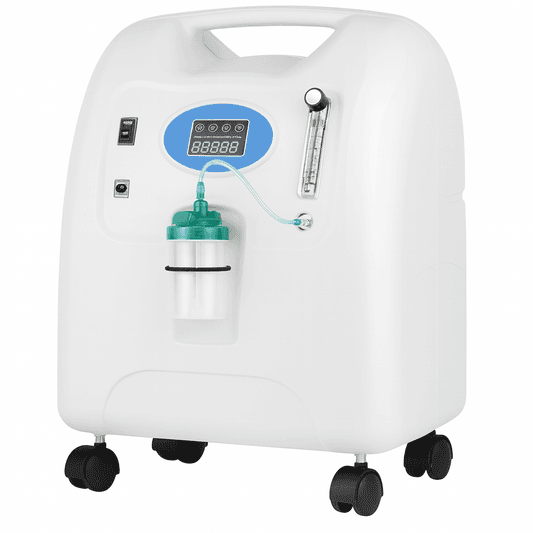
Put two oxygen concentrator datasheets side by side and they look interchangeable: both say "high purity", both say "low noise", both list a flow number in the model name. The real differences hide in the test conditions behind each figure — and that's where budget machines quietly diverge from clinical ones. If you buy for a clinic, a homecare fleet or an NGO program, learning to read those conditions is worth more than any brochure adjective.
One rule organizes everything below: a specification without its condition is not a specification. Purity is only meaningful at a stated flow. Noise is only meaningful at a stated distance. Power draw is only meaningful at rated output. Here is the datasheet, decoded line by line.
Flow: Rated vs "Maximum"
The flow class in the model name — 5L, 10L — should mean the rated flow: the setting at which the machine still delivers medical-grade purity continuously. Two things to verify:
- Adjustment range. A proper 10L unit adjusts from around 1 to 10 L/min on its flowmeter. If the datasheet shows "0.5–5 L/min (max 6)", it is a 5L machine with a marketing liter added.
- Purity at the top of the range. Some low-cost units physically reach their headline flow but lose purity there. The flow number only counts if purity holds at that flow — which is the next line.
Purity: The Number That Defines "Medical"
Medical concentrators deliver 93% ± 3% oxygen at rated flow, the benchmark reflected in ISO 80601-2-69, the particular standard for these devices. Reading purity claims:
- "Purity up to 96%" usually describes output at the lowest flow setting. Ask instead for the purity-vs-flow table — purity at 1, 2, 5, 10 L/min — and judge the machine at the flow you'll actually run.
- How purity is indicated matters. Better machines carry an oxygen sensor that displays live concentration and alarms when purity falls below threshold (typically 82–85%). Entry units may only have a timer-based service reminder — acceptable at the price point, but know which you're buying.
- Warm-up: concentrators take a few minutes after switch-on to reach stated purity; a spec sheet listing "purity reach time" is a good sign, not a defect.
Outlet Pressure
Usually 40–70 kPa on clinic-class machines. It matters in three cases: driving a nebulizer function, long cannula runs, and flow splitters (one 10L unit serving two low-flow patients in field programs) — splitting only works when outlet pressure stays stable at full flow. If your use case includes any of these, confirm pressure at rated flow, not at idle.
Noise: Ask "At What Distance?"
Noise figures are only comparable with a measurement distance attached. Sound level falls by several dB each time distance doubles, so "≤50 dB" measured at 3 m can describe a noticeably louder machine than "52 dB at 1 m". Homecare units typically sit in the 40s to low 50s dB(A) at 1 m; ward and high-flow units run louder. For bedside or bedroom use, the difference between 45 and 55 dB(A) is the difference between sleep and complaint — make the datasheet state the distance.
Power Draw and Voltage
Power consumption (W) sets the running cost your buyer lives with. As a planning figure, a ~600 W 10L unit running continuously consumes on the order of 430 kWh a month — in high-tariff markets, electricity can rival the machine's depreciation. Compare watts at rated flow between candidate models; efficiency differences of 20–30% are common.
Voltage is a build decision, not a switch: 110 V/60 Hz and 220 V/50 Hz machines use different compressors and transformers. Confirm the destination country's supply — and the plug type — on the order sheet. Mixed-voltage fleets for NGOs should be specified country by country. (Medical Oxygen Concentrator Buying Guide: 5L vs 10L, Purity and the Specs That Matter)
Duty Cycle, Compressor Hours and Sieve Life
Three lines tell you whether a machine is built for clinic duty:
- Duty cycle: clinic and ward machines should be continuous-rated (24/7 capable). If the sheet is silent, ask directly.
- Compressor rated lifetime hours: the honest long-term cost figure — thousands of hours, stated by the compressor maker. A machine priced 15% cheaper with half the compressor life is not cheaper.
- Sieve bed life: zeolite beds age with hours and humidity; they are the main mid-life service item. Ask for expected life and the replacement part price at quotation time, while you still have leverage.
Alarms and Protections: The Safety Baseline
A clinically usable machine should list, at minimum: power-failure alarm, high/low pressure alarm, low-purity indication (sensor-based on better units), high-temperature protection, and compressor thermal cutout. Treat this list as pass/fail rather than nice-to-have — and ask your supplier for a pre-shipment test video showing the alarms actually triggered, not just the power light; we support this on request. (oxygen concentrators)
Environment Ratings: The Forgotten Line
Concentrators are rated for an operating temperature band, a humidity ceiling and — critically for many programs — an altitude limit, commonly around 1,500–3,000 m. Above the rated altitude, thinner air degrades output and purity. If your machines are headed for highland regions, put the deployment altitude in the inquiry and ask the factory to confirm performance in writing.
Two "10L" Quotes, Read Properly
| Datasheet line | Unit A | Unit B | What it tells you |
|---|---|---|---|
| Flow | 1–10 L/min | 0.5–8 L/min, "max 10" | B is an 8L machine in a 10L costume |
| Purity | 93±3% at 10 L/min, O₂ sensor + alarm | "up to 95.5%" (flow unstated) | Only A commits to purity where it counts |
| Noise | 54 dB(A) at 1 m | "≤50 dB" (distance unstated) | Not comparable; B's figure is likely far-field |
| Power | 590 W at 10 L/min | 550 W (condition unstated) | Comparable only if both state rated-flow draw |
| Duty cycle | Continuous | — | Silence on duty cycle is an answer |
| Alarms | Power / pressure / purity / temp | "Multiple alarms" | Ask B for the itemized list |
Same headline, different machines. The cheaper quote may still be the right buy for light duty — but decide that knowingly.
The Checklist to Send the Factory
Copy this into your inquiry: purity-vs-flow table; outlet pressure at rated flow; noise in dB(A) with distance; power draw at rated flow; duty-cycle rating; compressor rated hours; sieve bed expected life and spare price; itemized alarm list; operating altitude/temperature limits; voltage build and plug for the destination; certification set (CE / ISO 13485) for the exact model. A factory that answers all eleven without friction is telling you something about the machine, too — that transparency is how we quote our own HP-V range, from the 1L HP-V01 to the 20L HP-V06.
FAQ
Is higher purity always better? Beyond the 93±3% medical band, extra points change little clinically at prescribed flows. Stability at rated flow beats a peak number at 1 L/min.
Why do two 10L machines differ so much in price? Compressor grade and rated hours, sieve quantity and quality, sensor-based purity monitoring, and build for continuous duty — the parts of the datasheet this guide covers — are exactly where the cost sits.
Can I run a concentrator on a generator or solar system? Yes, if the inverter handles the compressor's start-up surge — ask for start-up (peak) power, not just running watts, and size the supply with margin.
What documentation should arrive with a clinic order? User manual in your market's language, certification copies for the model, test report with serial numbers, and alarm/commissioning test video on request.
Comparing models for a clinic, fleet or program? Send us your flow requirements, destination and altitude — we'll return a purity-vs-flow table, full specs and pricing for the models that fit. → HOPE INTERNATIONAL