Ultrasound Probe Care and Machine Maintenance: Extending Service Life
October 11, 2026
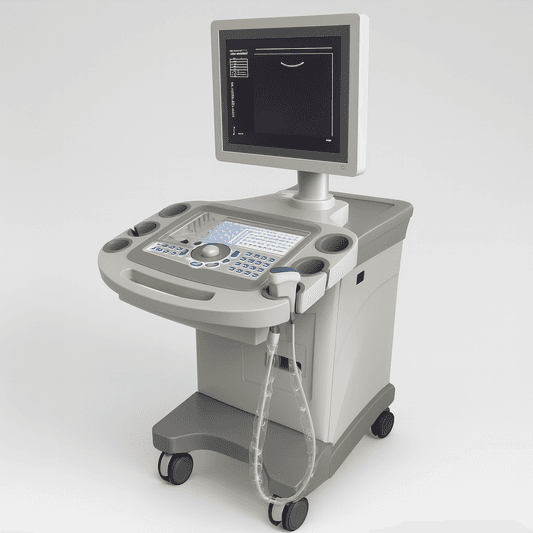
On most scanners the probes, taken together, carry more value than the console, and they fail in ways the console does not: a drop shatters ceramic, and a shattered array cannot be repaired element by element — once dropout is bad enough to shadow the image, the probe is replaced or fully remanufactured. A cable sheath crushed under a trolley wheel or a chair leg is usually a repair. A hole in the acoustic lens that lets fluid reach the array and corrode it often is not. The difference between those two outcomes is a handling policy, and it is the cheapest line item in your service plan.
The second avoidable loss is chemical. Lens delamination and lens degradation from incompatible disinfectants are standard entries on every probe damage list, and alcohol-based wipes are named repeatedly as an agent that dries out and damages the lens. A clinic that standardises on one wipe for every surface in the room, probes included, will retire probes early and call it bad luck. For a dealer, that is a warranty argument you can prevent by shipping the compatibility list with the machine instead of waiting to be asked.
Reprocessing level follows the contact, not the probe
The classification that drives everything downstream is the Spaulding one, and it is set by what the probe touches — which means the same probe can sit in two categories in two rooms.
| Use | Spaulding category | Minimum reprocessing | What this means commercially |
|---|---|---|---|
| Surface scanning on intact skin | Non-critical | Cleaning, optionally followed by low-level disinfection | Wipe compatibility is the only real constraint |
| Surface scanning on non-intact skin | Semi-critical | High-level disinfection | Needs a validated HLD route the probe tolerates |
| Endocavity scanning (transvaginal, transrectal) | Semi-critical | High-level disinfection | A sheath does not reduce the requirement |
| Use in a sterile field (e.g. vascular access) | Treated as semi-critical in practice | HLD plus a sterile sheath and sterile gel | Transducers are heat-sensitive, so sterilisation is generally impractical |
Two points from the guidance literature are worth repeating to any customer who argues with the table. A sheath does not change the level of disinfection required — a documented case found gouge marks on a probe head where a needle had punctured the cover during a line placement. And agent choice is probe-specific: Canadian infection-prevention guidance favours oxidising high-level disinfectants for endocavity probes on the basis that aldehyde-based products may not fully inactivate human papillomavirus, while Australian guidance accepts glutaraldehyde, orthophthalaldehyde and hydrogen peroxide products — but all of it is subordinate to the probe maker's own instructions for use, which is the document that controls compatibility and therefore the warranty.
The damage modes, and which ones are repairable
| Failure mode | Usual cause | How it shows | Usually repairable? |
|---|---|---|---|
| Dead elements (dropout) | Drop onto a hard floor; thermal stress | Vertical shadow or drop-out band in the image | No — replacement or full remanufacture |
| Lens cut, hole or delamination | Needle contact; incompatible disinfectant; abrasion | Near-field artefact, then noise as fluid enters | Lens replacement yes; corroded array no |
| Cable sheath damage | Trolley wheels and chair legs running over the cable | Intermittent image or dead sector when flexed | Often yes, model dependent |
| Strain-relief separation | The most handled part of the probe | Exposed cable at the housing joint | Yes, if caught before the conductors tear |
| Connector pin damage | Port insertion force; dropped connector | Probe not recognised, or noise on one port | Usually yes, and usually cheap |
| Housing crack / fluid ingress | Impact; immersion past the stated line | Erratic behaviour, safety test failure | Depends on what the fluid reached |
Two things follow for the dealer rather than the end user. First, the cheap failures — connector and strain relief — are the ones caught by a thirty-second visual check at each shift change, so a laminated check card in the box is worth more to your renewal rate than another brochure. Second, "we can repair any probe" is a claim to test: ask whether the quoted repair includes an electrical safety test and an image-quality verification after the work, because a re-lensed probe with a degraded array passes a visual inspection and fails in the room.
Where two scanner quotations actually differ
Two offers that both say "trolley scanner with three probes, two-year warranty" routinely differ in five places, none of which appear in the headline:
- Which probes. Model, frequency range and element count, not just "convex, linear, transvaginal".
- Whether the probe warranty equals the console warranty. Probes are often shorter, and the exclusions are usually broader.
- Spare-part availability horizon. How many years parts and probes remain available for this platform.
- Service access. Service manual, service-level password or dongle, and whether your own engineer may open the console without voiding cover.
- The compatibility list. Whether a written disinfectant and gel compatibility list ships with the machine.
Ask for those five in writing before you compare prices. A supplier who answers all five is quoting a serviceable installed base; a supplier who answers none is quoting a box.
RFQ fields, ordered by how much they move the price
- Probe set by model, with the application mix behind it.
- Warranty term, separately for console and probes, with parts-versus-labour scope.
- Warranty start: shipment date or commissioning date.
- Spare-part and probe availability horizon for the platform.
- DOA definition, replacement route and who pays freight each way.
- Service documentation and access level.
- Disinfectant and gel compatibility list, and sheath compatibility for endocavity probes.
- Voltage and frequency configuration, locked at order stage.
- Consumables to ship with the unit: gel, sheaths, thermal paper, spare fuses.
- Packing, markings and whether a wooden case needs heat-treatment marking for the destination.
Pre-shipment checks that prevent a DOA claim
Equipment is not inspected like consumables. The accessories box can be sampled under ISO 2859-1 at general inspection level II — and note that the acceptance numbers people quote from memory, AQL 1.5 under EN 455-1 in the EU or 2.5 under 21 CFR 800.20 in the US, belong to examination gloves and have nothing to do with scanners. For the machines themselves the useful discipline is a unit-level functional record: serial number, probe serial numbers, power-on test, image check on a phantom or test object, electrical safety test result, and the firmware version, all on one sheet that travels with the unit.
Ask for the serial numbers, the functional test and the firmware version to be recorded per unit and shared before the container is sealed, so a DOA claim starts from a document rather than an argument.
Packing, cube and the tariff lines
Scanners are a weight-and-protection problem rather than a cube problem, and trolley units change the maths entirely because the pedestal, not the carton, sets the footprint.
| Commercial term | What to fix in the purchase order |
|---|---|
| Packing | Carton or plywood case per unit, foam set, probe cases, and whether the trolley ships assembled or knocked down |
| Wood packaging | If a wooden case or pallet is used, it must carry the ISPM 15 treatment marking for most destinations — confirm before booking |
| Container planning | As planning figures a 20ft box takes roughly 26–28 m³ and a 40HQ roughly 65–68 m³ of export cartons; for cased equipment the pallet count and case dimensions govern, so take the figure from the loading plan |
| Incoterm and port of loading | State both. An EXW number, a FOB Ningbo number and a DDP number are three different prices, and air freight on a single trolley unit can exceed the duty line |
| HS lines | Ultrasonic scanning apparatus: 9018.12. Coupling gel: 3006.70. A probe shipped as a spare normally follows the apparatus heading, but the national ruling governs — confirm the line with your broker before the first spares order |
| Price basis | Per unit in USD by configuration, with an indicative band per configuration and a stated validity window rather than one open-ended list price |
The spares line is where a service business quietly leaks margin. Probes, gel and accessories entered under one "medical equipment" description on a consolidated spares invoice invite the broker to apply a single rate, and a gel shipment classified as a cosmetic preparation rather than a medical gel is a different duty line again. Split them on the invoice before the goods move.
Standards, registration and who signs what
| Market or topic | What applies | Status |
|---|---|---|
| Safety standard | IEC 60601-1 for basic safety and essential performance, with IEC 60601-2-37 as the particular standard for ultrasonic medical diagnostic and monitoring equipment | Confirmed with the quotation |
| EU | Active devices for diagnosis classify under Rule 10 of Annex VIII to Regulation (EU) 2017/745 and are typically Class IIa, which means notified body involvement and an EU authorised representative on record | Confirmed with the quotation |
| US | Diagnostic ultrasound systems are regulated as radiology devices under 21 CFR part 892 and go through premarket notification; a US agent is required for a foreign establishment | Confirmed with the quotation |
| Group quality system | Our export sales of hospital beds, oxygen concentrators, nebulizers, laboratory and surgical equipment run under the group's ISO 13485:2016 and ISO 9001:2015 certified quality management system (certification body ZQHX, issued November 2025, valid to November 2028) | Confirm coverage for ultrasound with the quotation |
The practical reading for a distributor: ask who the legal manufacturer on the label is, who the EU authorised representative is, and who the US agent is, and get all three before you tender. Those three names decide who answers a field complaint, and a tender that asks for them mid-process is a tender you lose on paperwork rather than on price.
Warranty, spares and lead time
Minimum order quantity in this category is counted in units rather than containers, which is why a first order is usually a demo unit plus the spares holding needed to support it — and why the service clauses matter more than the unit price. Three clauses decide whether a warranty is worth its headline. The start date — shipment or commissioning — can move the effective cover by a whole shipping and installation cycle. The parts-versus-labour split decides who pays an engineer's day. And the exclusions decide whether probes are in or out: rough or careless handling is excluded from essentially every equipment warranty in this category, which is exactly why the handling policy above is a commercial document and not housekeeping advice.
Ask for the warranty start basis, the parts-and-labour scope and the probe exclusions to be confirmed in writing with the order acknowledgement rather than left to the brochure.
Lead time on configured equipment is production plus configuration plus test, and the voltage and frequency build is the step that most often slips. A 220 V/50 Hz unit and a 110 V/60 Hz unit are two builds, not a switch setting, so changing it after the order is placed re-queues the unit.
Change control and traceability
Ask for a written product change notification policy covering a change of platform revision, probe revision, firmware or production site: how many working days of notice, and whether your written agreement is required. Probe revisions are the specific risk here — a "same model" probe at a newer revision can need a console software update to be recognised, and finding that out in a customer's room costs a service visit you did not quote for.
Then ask for the traceability basics: the serial-number scheme and where it is printed, the firmware version shipped, how long retained service records are kept, and the recall entry point.
Ask for the shipped firmware version and the probe serial numbers to be logged against each console serial number, and for that list to come with the shipment.
When probe replacement is the wrong purchase
If a probe shows dropout and the console is at the end of its parts horizon, replacing the probe can cost a meaningful share of a new scanner while leaving the customer on a platform you can no longer support. Price the probe and the replacement unit side by side and tell the customer both numbers. Dealers who do this keep the account; dealers who sell the probe keep the invoice.
FAQ
When does the warranty start, and what does it cover? Term, the parts-versus-labour split and the start basis — shipment or commissioning — are all stated per order, and the probe cover is stated separately from the console because it is usually narrower.
How long will probes and spare parts stay available for a platform? Ask for the availability horizon in years before you order, and build your own spares holding from it; it belongs in the quotation, not in a conversation after the first failure.
Can you ship spare probes and gel with the first order? Ask for it with the first order — it is the cheaper way to do it — a separate spares shipment later means a second freight bill and a second customs entry on its own tariff lines.
What happens on a DOA unit? The definition, the replacement route and who pays freight each way should be fixed in the purchase order; a pre-shipment serial and functional record is what makes that claim quick to settle.
What to send us
Send the probe set and application mix, the destination market and voltage, the warranty and spares horizon you need to tender with, and your annual volume. You get back the configuration quoted per unit in USD, the pre-shipment test record format, and the disinfectant and gel compatibility list for the probes concerned.
Start from the ultrasound machine supplier range, compare a trolley ultrasound scanner against a portable ultrasound scanner for the same account, and see patient monitoring equipment supplier for the room around it. Probe selection itself is covered in our ultrasound probe types guide.